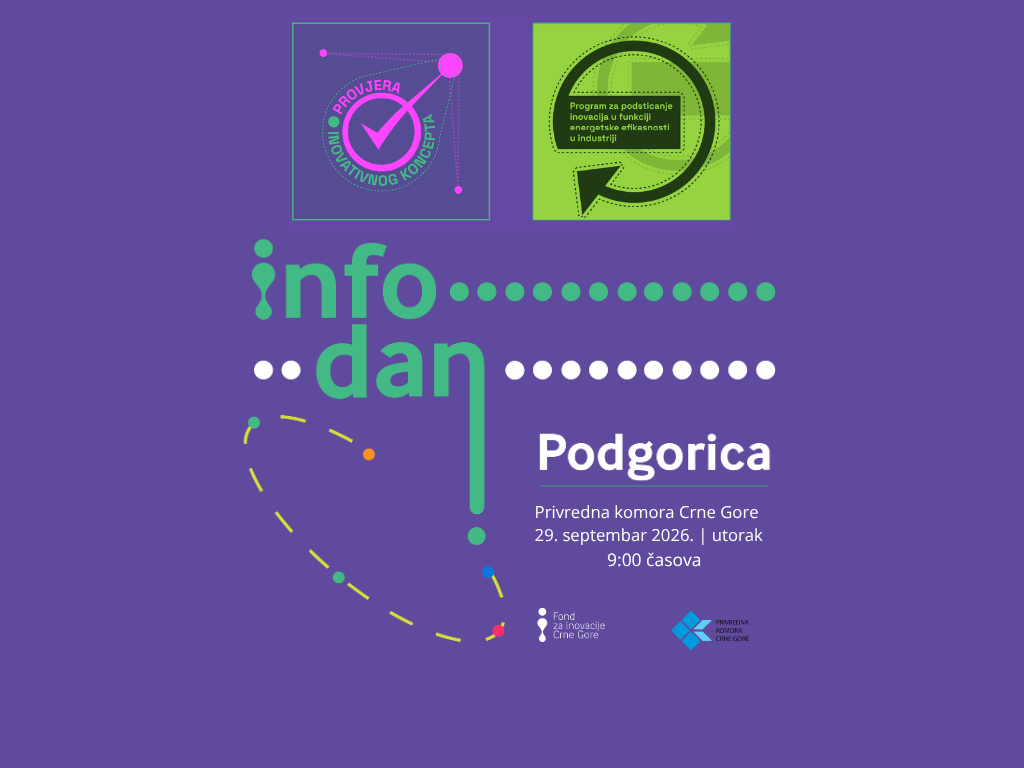

The Public Call for the Proof of Concept Programme was published by the Innovation Fund of Montenegro on 25 July 2024 and remained open until 30 September 2024.
The aim of the programme is to support innovation at the earliest stages of research, in order to demonstrate the feasibility of new processes or technologies and their potential for commercial application.
For the implementation of this programme, the Innovation Fund allocated a budget of EUR 350,000, with support per project ranging from EUR 20,000 to EUR 40,000.
Thanks to savings in operational costs and unspent funds from other programme lines, the total amount of available support was increased to EUR 371,428.82, enabling the financing of 11 projects. A total of 32 applications were submitted to the Public Call, of which 24 met the administrative criteria and were referred for international evaluation.
The projects were evaluated by three independent international experts, and only the most promising projects were selected for funding. The programme supports projects at TRL 3 to TRL 4, with a planned implementation period of 4 to 12 months.
The main objective of the programme is to strengthen the research, development and innovation capacities and capabilities of the private sector and scientific research institutions, as well as to provide pre-commercial capital for the validation of innovative solutions.
List of beneficiaries: [LIST]
Fund recipients
Project name
Innovative Technology for Smart Management of Residential Spaces
Project description
The IndoorTech project focuses on the development of an advanced AI/IoT system designed to revolutionize the management and automation of indoor spaces in hotels and residential units. Unlike traditional solutions, IndoorTech integrates advanced technologies to provide a comprehensive approach to indoor environment management. One of the key advantages of this system is its ability to intelligently adapt the functionality of devices based on users’ habits and behaviour, without collecting sensitive personal data.
Project name
High-Sensitivity Converter
Project description
The High-Sensitivity Converter project focuses on the development of an advanced solution for converting analogue signals from the environment into digital equivalents suitable for further processing by computer systems. This process enables the precise conversion of analogue electrical quantities into digital data through an electronic circuit known as an analogue-to-digital converter. These converters are an integral part of almost all modern electrical devices, ensuring their efficiency and accuracy. The project aims to advance existing technologies in this field.
Project name
Development of a Prototype for the Technical Testing of Anchor Bolts
Project description
This project is focused on the development of an innovative prototype for the technical testing of anchor bolts under field conditions. Anchor bolts are widely used in civil engineering and mechanical structures, as well as in equipment installation, to ensure a secure connection to concrete, stone, or other construction materials. The project proposes testing a prototype that enables anchor bolts to be tested across a wide range of applications. During testing, particular attention will be paid to monitoring the most important parameters, which provide insights not only into the quality of the installation itself, but also into the quality of the substrate into which the bolts are installed, as well as the characteristics of the anchor bolt itself.
Project name
Prefabricated Eco-Houses for Tourism
Project description
The aim of this project is to construct and test a prototype of a prefabricated eco-house designed for sustainable tourism in Montenegro. This prototype will serve as a basis for the further development of residential units suitable for year-round living and wider application in both rural and urban areas.
Project name
Cloud Observation from the Earth’s Surface Using Machine Learning Methods
Project description
The project envisages the development and implementation of a machine learning (ML)-based module aimed at automating the observation of clouds from the Earth’s surface. This module will be integrated into the information system of the Institute of Hydrometeorology and Seismology of Montenegro (ZHMS), enabling more precise and efficient monitoring of atmospheric changes, improved meteorological analyses, and enhanced weather forecast accuracy.
Project name
Verification of Honey Authenticity Using AI Technology
Project description
The PollenTrace project is developing an innovative data-driven platform that enables accurate verification of honey authenticity through pollen analysis supported by artificial intelligence. By applying advanced machine learning and computer vision models, the platform enables detailed analysis of pollen composition, allowing the geographical and botanical origin of honey to be determined with a high degree of accuracy. This technology has the potential to improve the quality control and authenticity verification of honey, providing reliable information to consumers and producers.
Project name
Design of Innovative Pyrophyllite-Based Filters for the Sorption of Dyes from Wastewater
Project description
The aim of this project is to develop innovative filters based on mechanically and chemically activated pyrophyllite, which has proven to be an effective solution for the adsorption and removal of harmful dyes from wastewater. The application of this method is expected to significantly contribute to improving water quality and reducing the negative impact on aquatic ecosystems.
Project name
Advanced AI-Powered Collection Debt System
Project description
This project focuses on the development of an advanced debt collection model based on the analysis of customer behaviour, including payment and delay patterns. The aim of the project is to validate the concept that segmenting customers according to their habits can significantly improve collection efficiency and optimize revenue. By using artificial intelligence (AI) technologies, the system will enable more accurate risk prediction and the adaptation of collection strategies, thereby achieving greater financial stability and improved business performance.
Project name
Innovative Prototype and Method for Portable Healthcare Devices – HealthTalk
Project description
The HealthTalk project involves the development of a functional innovative prototype and accompanying methods for monitoring vital health parameters in real time. This advanced device will enable the recording of and timely alerts for abnormalities in the user’s health status, including temperature, heart rate, respiratory rate, coughing, blood oxygen saturation, and cardiac activity, with a particular focus on arrhythmias and pre-stroke events. In addition, HealthTalk will enable the detection of physical falls, abnormal movement, and activity during sleep, thereby contributing to improved quality of life and the prevention of serious health conditions through early detection and intervention.
Project name
SolarDrone: Thermal Diagnostics of Solar Panels Using Drones and Artificial Intelligence
Project description
The SolarDrone project aims to advance solar panel inspection technology through the integration of drone-based thermal imaging and machine learning. This innovative method enables the automated detection of defects, significantly increasing the efficiency and accuracy of inspections. Current solar panel inspection methods are labour-intensive and require direct human involvement, which limits efficiency and scalability. By implementing drones with advanced algorithms for analysing thermal data, SolarDrone contributes to optimizing maintenance processes, reducing costs, and extending the lifespan of solar panels.
Project name
Survey.me
Project description
This project proposes the development of an innovative survey platform that will transform the way data is collected online by enabling remote research into human behaviour. The platform uses advanced neuroscience insights and integrated tracking methods, including mouse movement tracking technology, to enable detailed remote observation of user behaviour. This method provides insight into the emotional, cognitive, and motor responses of participants, enabling deeper analysis of interactions and facilitating informed, data-driven decision-making.