

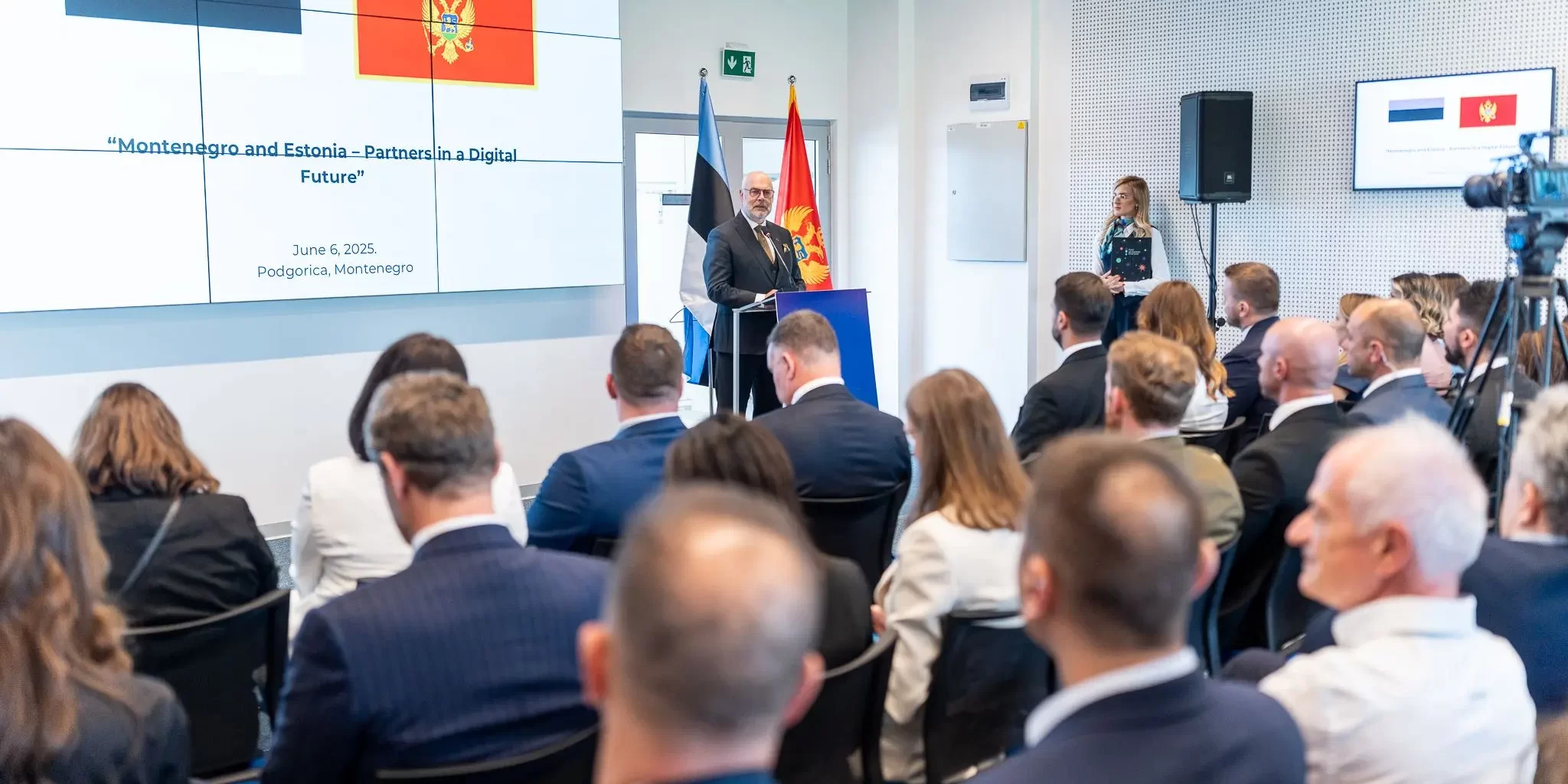
Montenegro and Estonia further strengthened their partnership in digital transformation and innovation during the first official visit of the President of the Republic of Estonia, Alar Karis, to Montenegro. On this occasion, Presidents Karis and Milatović visited the Innovation Fund and the Science and Technology Park, where they delivered a joint lecture titled “Montenegro and Estonia – Partners in the Digital Future,” accompanied by additional presentations from Hannes Astok, Director of the e-Governance Academy of Estonia, and Bojana Femić-Radosavović, Executive Director of the Innovation Fund.
The event was held on June 6th in Podgorica and brought together numerous representatives of the innovation community, institutions, startups, and academia.
“It is my great pleasure to welcome you to the Science and Technology Park of Montenegro a place that reflects our aspirations and belief that the future is built through knowledge, creativity, and collaboration. I am especially honored to host you here, President Karis, during your official visit to Montenegro. Estonia is globally recognized as a leader in digital transformation and e-governance. Your presence here today is a strong symbol of deepening ties between our two countries not only politically and economically, but also in the field of innovation and technological progress.


The Science and Technology Park is not just a building. It is a living ecosystem designed to connect startups, researchers, academic institutions, and private companies. It is a place where ideas are born, tested, and turned into solutions that have the power to transform not only our economy, but also improve the quality of life for our citizens.
Through coworking spaces, business incubators, and access to mentorship, the Park offers fertile ground for entrepreneurs, scientists, and visionaries. It is a place where young people in Montenegro are not only encouraged to think boldly but are also given the necessary tools and support. We do not view digital transformation merely as an internal priority of our Government and society, but as a bridge to our shared European future. By adopting best practices from countries like Estonia and investing in our infrastructure and human capital, Montenegro is laying the foundation to become a fully integrated, competitive, and resilient member of the European family.
We understood early on that without innovation, there is no sustainable progress. That is why our policies are increasingly focused on digital skills, technological entrepreneurship, and international cooperation. In this context, Estonia is not just a partner but also an inspiration. You have shown the world what can be achieved when a country fully embraces digital transformation and innovation. From digital public services to transparent governance, your example serves as a beacon for countries like Montenegro that wish to step into the future with greater confidence.
That is why I believe today’s visit will be a dialogue of shared experiences and ambitions. Let this be the beginning of deeper institutional cooperation, new joint projects, and a stronger European digital future for Montenegro,” said President Milatović in his address.
In his speech, the President of Estonia, Alar Karis, emphasized that his country is now globally recognized as a digital nation, one that has built its development on the values of efficiency, transparency, and accessibility. He highlighted that digital solutions must serve citizens and contribute to improving their everyday lives.
He particularly emphasized Estonia’s readiness to share its experience with Montenegro, especially in the areas of e-governance, cybersecurity, and education. He also announced a new initiative: starting next school year, Estonia will introduce a program to integrate artificial intelligence into the education system, making AI an integral part of daily work and learning in classrooms.
“Estonia stands before you today as a nation that has built its future on digital foundations. We have created a society where technology serves people not the other way around. Montenegro is among the countries that have expressed a desire to learn from our model and implement similar solutions. Together, we can build bridges between our strengths and create solutions that serve both citizens and the world,” said President Alar Karis.
The digital transformation of Estonia, as explained by Hannes Astok, Director of the e-Governance Academy of Estonia, began at its core by digitalizing registries. In the post-Soviet era, there was no practice of maintaining electronic business or land registries, so the digital path started from scratch, with strong support from Finland and Sweden.
By digitalizing from the ground up, Estonia laid the foundations for a modern e-government. “As long as data exists only on paper, you cannot speak of a digital state,” Astok noted, emphasizing that access to digital services is only possible if the state first digitizes its own records.
Given the country’s size and limited resources, Estonia relied on efficiency and innovation. With a population of 1.3 million, it was clear the administration could not develop along the lines of larger countries. Instead, automated services were developed that save time, reduce costs, and increase the accessibility of services to citizens.
One key example is the digital sale of cars a process in Estonia conducted entirely online, without physical presence or bureaucracy. The state already has the necessary data, so ownership is transferred via digital signature between the two parties, without any intermediary official.
Beyond efficiency, the dignity of citizens was highlighted digital governance enables equality by eliminating unnecessary waiting and subservience to administration. In this spirit, Estonia is now home to more than ten “unicorn” companies those valued at over a billion euros the highest per capita in Europe.
In closing, the Director of the e-Governance Academy emphasized that innovation always carries risk, and it is a mistake to believe that governments must never err. Small countries, he said, must be brave, experiment, and learn quickly from failure. This is precisely the path Montenegro can follow – smart, digital, and with a clear vision.
Addressing the event participants, Bojana Femić-Radosavović, Executive Director of the Innovation Fund of Montenegro, said that Montenegro has entered a new phase of development one where innovation is recognized as a driver of economic and social progress.
The Innovation Fund, as the youngest institution within the innovation ecosystem, has quickly become an example of efficiency. Thanks to its expert team and clearly defined principles; excellence, transparency, and ethics, the Fund has successfully launched programs that provide real support to innovators.
“Our goal is clear: to create an environment in which innovators not only develop ideas, but also successfully commercialize them. And to ensure they know they are not alone on that path,” said Femić-Radosavović. “Today, we can rightfully say that Montenegro has established a comprehensive and functional national innovation support system. The Ministry of Education, Science and Innovation is responsible for shaping innovation policy, and under its umbrella operate three state entities: the Innovation Fund, which finances innovation through various support programs; and the innovation infrastructure the Science and Technology Park of Montenegro with the Technology Transfer Office, and the Innovation and Entrepreneurship Center Tehnopolis in Nikšić.”
This year is of special significance, as several new initiatives are planned:
- Launching a public call to select a global partner for implementing an acceleration program and establishing a regional accelerator focused on sustainability and artificial intelligence;
- Initiating a GovTech call aimed at developing innovative solutions in the public sector, with the active involvement of the Ministry of Public Administration;
- Undertaking serious preparations for the management of structural funds, beginning with the Fund’s participation in a call financed under the IPA III instrument.
The Government of Montenegro’s commitment to innovation is perhaps best reflected in its budget allocations. Initially financed solely from the national budget, the Fund has since received additional EU funds, and this year also a significant donation under the Investment Program of Special Importance for the Economic Interest of Montenegro. As a result, the Fund’s budget has increased tenfold over the past three years an achievement we are extremely proud of, Radosavović emphasized.
Sustainable development of the innovation ecosystem requires strong cooperation between academia and the private sector. We are pleased to witness the strengthening of this cooperation year after year and the growing number of exceptional ideas emerging from it.
We are equally committed to supporting all phases of innovation development. Thanks to the national support framework, every individual or team in Montenegro with an innovative idea can receive both financial and mentoring support from the initial idea to commercialization.
While Estonia fosters a culture open to risk, our society still experiences a more pronounced fear of failure, making the development of a resilient and confident innovation culture especially important. The first step in that direction is education starting from the earliest age.
Our pilot project “Robotics for the Youngest,” launched in 2022 with the support of the Ministry of Education, Science and Innovation, has, thanks to the support of the Central Bank of Montenegro, evolved into a national initiative. Donated funds enabled the purchase of educational robots for every primary school in Montenegro, as well as the training of teachers to use them particularly in teaching financial literacy through practical problem-solving. In the coming school year, we plan to organize a student competition within this initiative, with active participation from both Tehnopolis and the Science and Technology Park.
“Although Montenegro does not yet have a ‘unicorn’ company – and we would be satisfied with even half the number Estonia has we sincerely believe that through a joint and inclusive approach, and collaboration with countries like yours, we can become recognized as a nation of innovation,” Radosavović concluded.
For the Innovation Fund of Montenegro, such meetings confirm the importance of open dialogue and experience exchange in developing a modern innovation system. We firmly believe that cooperation with countries leading in digital transformation, such as Estonia, is a valuable asset in our continued development. We remain committed to creating an environment that recognizes, supports, and encourages innovation through concrete programs, international partnerships, and strategic initiatives.
www.fondzainovacije.me